Why Chimney Flashing Fails and Lets in Rain
23 November 2026
Share
What Makes Chimney Flashing Let Water In
Chimney flashing fails when the lead sealing the joint between chimney and roof cracks, lifts or loses its mortar fixing, letting rain run behind it into the attic. In Longford and across Ireland, wind-driven rain finds these weak joints fast, making flashing a common cause of ceiling stains near the chimney breast.
This article explains what chimney flashing is, the main reasons it fails, how to tell the flashing is the problem rather than the slates or the chimney itself, and what a proper repair involves.
What Chimney Flashing Does on a Pitched Roof
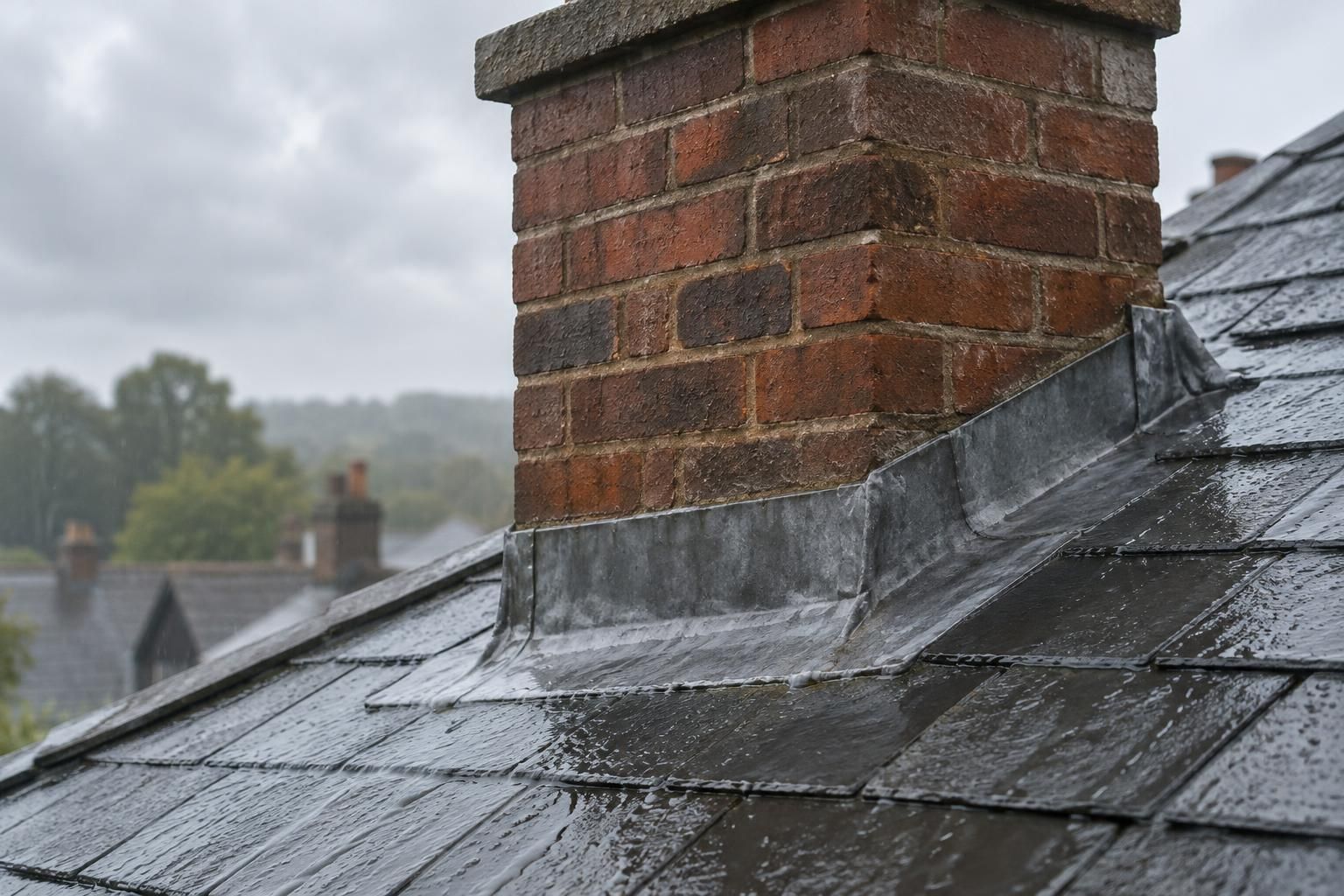
A chimney is a solid mass of brick or block that rises through a roof that moves, expands and contracts with the weather. The roof covering of slates or tiles cannot simply butt up against the masonry, because water would run straight down the face of the chimney and into the gap. Flashing is the waterproof barrier that bridges this joint. It is usually formed from sheet lead, although aluminium, zinc and various sealed strip products are also used.
On most chimneys the flashing is built up from several separate parts, and each part has its own job:
- The front apron sits on the lower face of the chimney and sheds water onto the roof covering below.
- The step flashings, or stepped cover flashings, run up the sloping sides of the chimney and are tucked into the mortar joints.
- The back gutter, sometimes called a tray, sits behind the chimney on the upper side and carries water around to the sides.
- Soakers or lead tails sit under the slates or tiles beside the chimney and direct water over the top of the roof covering.
When all of these parts work together, water is passed from one to the next until it reaches the roof covering and runs into the gutter. When one part fails, the water has a direct route into the attic.
Cracked Mortar and Failed Pointing Around the Flashing
The upper edge of the step flashings is normally turned into a groove cut into the brickwork, known as a chase, and held with wedges and sealed with mortar. Over the years Irish frost and rain break down that mortar. Once it crumbles, the lead is no longer held tightly to the chimney and water runs behind it.
Many failed flashings were originally sealed with a bead of mastic or cement fillet rather than being properly dressed into the brickwork. A cement fillet shrinks, cracks and falls away as the chimney and roof move at different rates, and a mastic bead hardens and splits in sunlight. Both give a quick fix that may last a season or two, but neither is a lasting repair. If you want to understand how the masonry itself is repaired, our guide on how chimney repairs and repointing protect your home covers the pointing side in detail.
Lead Flashing That Has Lifted, Split or Corroded
Lead is a long-lasting material, but it is not immune to damage. Lead expands and contracts noticeably with temperature changes. If a long run is fixed rigidly with no allowance for movement, it will work-harden and eventually crack, usually at the corners and the folds. Lengths that are too long or laid too thin are particularly prone to this.
Wind can also lift loose flashing. Once the edge of a lead apron is raised, rain is blown underneath it and the fixings behind it loosen further. Birds and storm debris can also pull at the edges.
Thin or poorly chosen metal is another common problem. Flashings need to be cut from lead sheet of a suitable thickness for the position, and the thinnest sheet is not a good choice for a chimney that takes the full force of the weather. Where an older flashing has been patched several times with different materials, the mix of metals and sealants can cause the joints to deteriorate faster.
Missing or Poorly Fitted Back Gutters
The back of a chimney is where the most water collects, because the chimney sits like a dam across the slope of the roof. If there is no back gutter, or if it has been made too shallow or too narrow, water pools against the masonry and overflows into the roof. A back gutter also needs a gentle fall so that it drains properly to the sides.
Leaves, moss and debris can collect in this area and block the flow. A blocked back gutter is a regular cause of leaks that appear only in heavy rain, which makes them harder to trace. It is worth checking from the attic after a storm, as the timing of the stain often points to this part of the flashing.
Signs the Chimney Flashing Needs Repair
Some signs can be seen from the ground, and others only show up inside the house or from the attic. The most reliable ones include:
- Brown or yellow staining on the ceiling or wall near the chimney breast, especially after wind-driven rain.
- Damp patches or flaking paint on the chimney breast inside a bedroom or living room.
- Daylight or wet timbers visible around the chimney stack from the attic.
- Lead that is visibly lifted, split, bulging or hanging away from the brickwork.
- Grey, dried-out cement or mastic around the base of the chimney where it meets the roof.
- Slipped or cracked slates or tiles beside the chimney.
If you spot any of these, avoid climbing onto the roof yourself. A roof is slippery in winter and chimneys sit on the steepest parts. Binoculars from the garden will usually show enough to describe the problem to a roofer.
Telling Flashing Leaks From Other Roof Leaks
A stain near a chimney does not always mean the flashing has failed. Cracked chimney pots, a failed flaunching on the chimney top, porous brickwork, condensation inside an unused flue and slipped slates nearby can all produce similar damp. A careful inspection looks at the whole stack from the top down rather than assuming the cause.
A quick check is to note when the damp appears. Leaks that show up only during heavy, wind-driven rain often come from the flashing or the chimney top. Damp that appears in cold weather without much rain can be condensation from an unused flue. Our guide on the common causes of roof leaks and how they are repaired sets out how each type of leak is traced.
How a Proper Chimney Flashing Repair Is Done
A repair that lasts is a matter of doing each stage properly rather than smearing sealant over the problem. In outline, the work usually follows these steps:
- Inspect the whole chimney, flashing, pointing, flaunching and surrounding slates or tiles to confirm the true source of the leak.
- Remove the old flashing, mastic and cement fillet, and clear out loose mortar from the chase.
- Repair any defective pointing and the roof covering beside the chimney so the new lead has a sound base.
- Fit new soakers, a back gutter with a proper fall, step flashings and a front apron, cut and dressed to the roof profile.
- Fix the upper edges of the lead into the chase with wedges and seal it with mortar or an approved lead sealant, leaving the lower edges free to move.
- Check the finished work and clear away all debris.
This work is carried out as part of our chimney repairs service, and where the leak has also affected the roof covering we can deal with that under our roof repairs service at the same visit.
Keeping Chimney Flashing in Good Condition
Once the flashing has been repaired it needs only a little attention to stay sound. A short visual check each autumn, after the leaves have fallen and before the worst of the winter storms, is usually enough. Look for any lifted edges, new gaps at the brickwork and moss or leaves building up behind the chimney. If a stack has a lot of moss, it is better to have it cleared by someone who can work at height safely.
It is also worth having the flashing looked at after a severe storm, since high winds are a common cause of lifted lead. Catching a small gap early costs far less than repairing rotted rafters and ceiling plaster later.
Next Steps for Chimney Flashing Problems
Chimney flashing fails for a handful of predictable reasons, from crumbling mortar and cracked lead to a missing back gutter, and almost all of them can be put right with a properly dressed lead repair. If you have a damp patch near a chimney in Longford, Edgeworthstown or elsewhere in Ireland, having the chimney flashing checked sooner rather than later will protect your timbers and ceilings through the winter.
To arrange an inspection, visit our contact page, call us on 085 754 7244 or email patrickhannifinroofing@gmail.com.
Recent Posts