Why Dry Verge and Dry Ridge Systems Suit Irish Roofs
26 October 2026
Share
The Problem With Mortar on Roof Edges
Walk down almost any road in Ireland and you will see it: crumbling grey mortar along the gable edges of tiled roofs, ridge tiles sitting slightly out of line, and small chunks of sand and cement lying in the gutters. For decades, the verges and ridges of Irish roofs were bedded in mortar. It was cheap and quick to apply, but it was never designed to cope with years of driving rain, frost and Atlantic storms.
Mortar is rigid. A roof is not. Timber rafters and battens expand and contract with the seasons, and the whole structure flexes slightly in high winds. Over time, that movement opens hairline cracks in the mortar. Rain gets into those cracks, freezes on cold nights, expands and breaks the mortar apart from the inside. Once the bond fails, verge tiles and ridge tiles can loosen and lift in the next storm.
This is why so many homeowners find themselves paying for the same repointing job every few years. Dry verge and dry ridge systems solve the problem at its source by removing the mortar altogether and fixing the roof edges mechanically. In this article we explain how these systems work, why they perform so well in the Irish climate, and what to expect when they are installed.
What a Dry Verge System Is
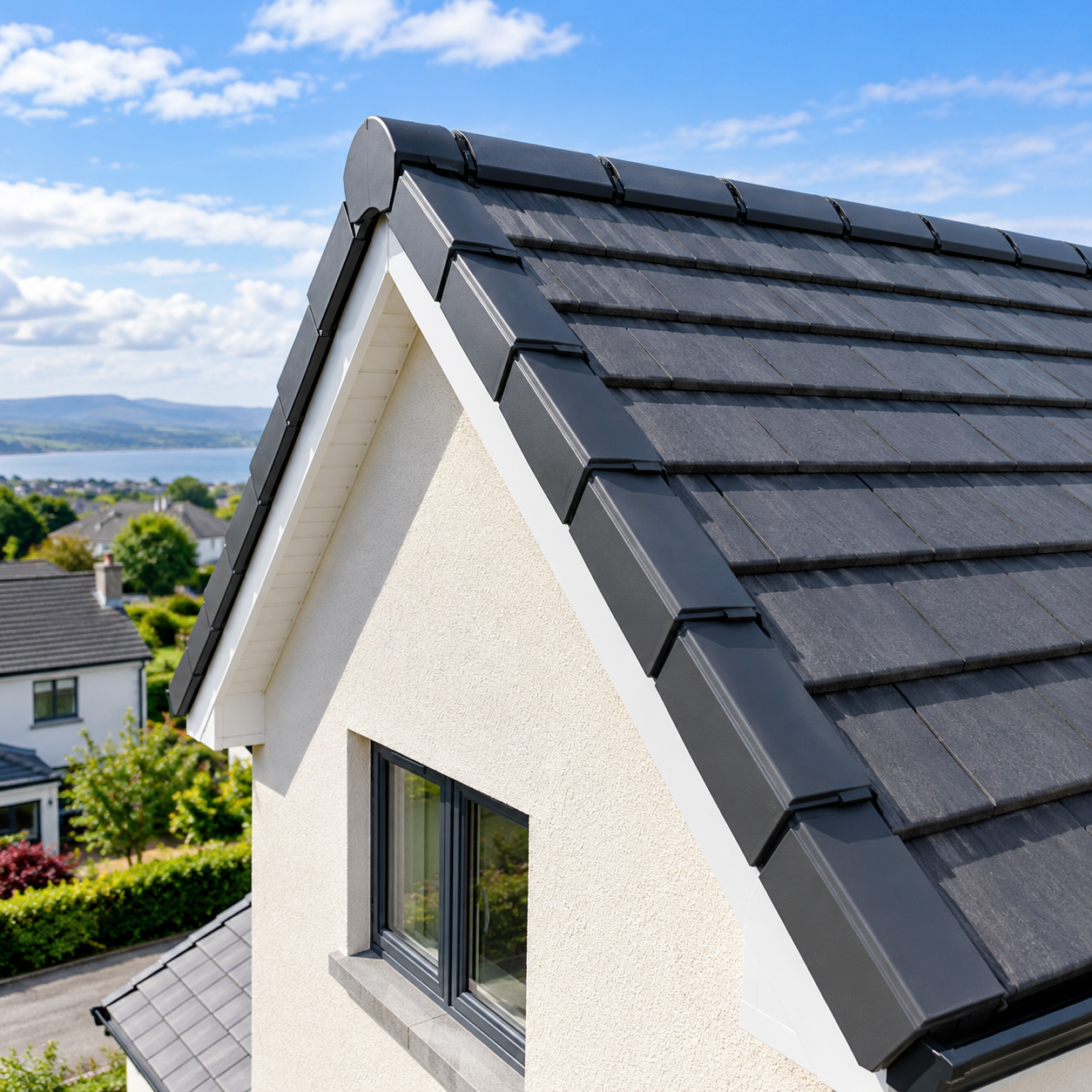
The verge is the sloping edge of a roof where the tiles finish at the gable wall. On a traditional roof, the last row of tiles along this edge is bedded on a strip of mortar laid over a fibre cement undercloak. A dry verge system replaces that mortar with a series of interlocking caps, usually made from tough, UV stabilised uPVC.
Each cap clips over the end of a tile and is screwed or nailed directly to the end of the roof battens. The caps overlap one another from the eaves up to the ridge, creating a continuous, weatherproof edge that holds every tile securely in place. Because nothing is bonded with cement, there is nothing to crack, crumble or wash out.
Dry verge systems are available in a range of colours, including black, brown, grey and terracotta, so they can be matched to the existing roof tiles. They give the gable edge a clean, uniform finish that looks tidy and modern on both new builds and older homes. You can read more about our dry verge and dry ridge installations on our service page.
What a Dry Ridge System Is
The ridge is the horizontal line along the top of the roof where the two slopes meet. Traditionally, each ridge tile is laid on a thick bed of mortar. A dry ridge system replaces that bed with a timber ridge batten fixed to the roof structure, a flexible ridge roll that seals the gap between the ridge tiles and the main roof tiles, and a set of clips and screws that fix each ridge tile firmly to the batten.
The result is a ridge that is mechanically secured along its whole length. In high winds, the tiles cannot lift away from the roof because each one is physically fixed in place rather than relying on a mortar bond. Union clips or seals cover the joints between ridge tiles, keeping rain out while allowing the roof to move naturally.
Ventilation at the Ridge
Many dry ridge rolls are designed to be breathable or vented. This allows warm, moist air to escape from the roof space at the highest point of the roof, which helps to reduce condensation in the attic. Condensation can lead to damp insulation, mould on the underside of the roof and rot in timber over time, so better airflow at the ridge is a real benefit for Irish homes, where damp air is a constant concern.
Why These Systems Perform Well in Irish Weather
The Irish climate is particularly hard on mortar. Rainfall is frequent and often wind-driven, which means water is pushed into every small gap on a roof. Winters bring repeated cycles of freezing and thawing rather than long, settled cold spells, and each of those cycles weakens mortar a little more. Exposed sites in the Midlands, along the west coast and in open countryside also see regular strong gusts during autumn and winter storms.
Dry fixed systems are designed for exactly these conditions. Because each component is mechanically fixed, wind uplift is resisted by screws and clips rather than by a brittle bond. Because there is no mortar, there is nothing for frost to break apart. And because the components are made from durable, weather resistant materials, they keep their shape and finish for many years with very little attention.
Current roofing practice in Ireland and the UK has moved firmly towards mechanically fixing ridges and verges, and most roof tile manufacturers now recommend or supply their own dry fix systems. For homeowners, this means a dry verge or dry ridge is not a novelty, but the standard way a well built roof edge is finished today.
The Main Benefits for Homeowners
The biggest benefit is simple: you stop paying for repeat repairs. Once a dry verge or dry ridge system is fitted correctly, there is no mortar to repoint every few years, and no loose tiles to reset after every storm. Over the life of the roof, that saving can be considerable.
- Low maintenance. No repointing, no patching and no crumbling mortar in your gutters.
- Storm resistance. Every verge cap and ridge tile is mechanically fixed, so it is far less likely to lift or slip in high winds.
- Weather tight edges. Interlocking caps and ridge seals keep driving rain out of the roof edges and gable walls.
- Better roof ventilation. Vented ridge systems help moist air escape from the attic and reduce condensation.
- A neat finish. Colour matched caps and straight ridge lines give the roof a clean, uniform appearance.
- Safety. Falling mortar and loose tiles are a hazard for anyone below. Dry fixing removes that risk.
Signs Your Roof Edges Need Attention
Many homeowners only notice problems with their verges and ridges after a storm. It is worth checking your roof from the ground a couple of times a year, especially after a spell of high winds. Use binoculars if you have them, and never climb onto the roof yourself.
- Cracked, gapped or missing mortar along the gable edges or under the ridge tiles
- Pieces of sand and cement collecting in the gutters or on the ground below
- Ridge tiles that look uneven, out of line or have visible gaps between them
- Verge tiles that appear loose or have slipped down the slope
- Damp patches on the inside of a gable wall or in the attic near the ridge
Any of these signs means water may already be getting into the roof edges. Acting early usually keeps the repair simple. Our team can carry out a full check as part of our roof repair service and let you know whether a repair or a dry fix upgrade makes more sense.
How a Dry Verge and Dry Ridge Installation Is Carried Out
On an existing roof, the work begins with careful removal of the old mortar from the verges and ridge. The ridge tiles are lifted and cleaned so they can be reused where they are in good condition. The verge tiles, undercloak and battens are checked, and any rotten timber or damaged tiles are replaced before anything new is fitted.
For the ridge, a new ridge batten is fixed in place, the ridge roll is laid along the full length of the roof, and each ridge tile is screwed or clipped down. Joints are sealed and the end of the ridge is closed off with a purpose made end cap. For the verge, the caps are fitted from the eaves upwards, each one fixed to the batten ends and locked into the cap below it.
On most houses, the work is completed within a day or two, depending on the size of the roof, the access and the condition of the existing tiles. Because the system is fixed mechanically, there is no curing time and no waiting for dry weather for mortar to set. For new roofs, dry verge and dry ridge systems are fitted as part of the main installation. You can see more about this on our new roof installation and tile and slate roofing pages.
Suitable Roof Types
Dry verge and dry ridge systems are most commonly fitted to concrete and clay tiled roofs, which cover a large share of Irish homes. Matching systems are also available for many slate roofs. During a survey, we check the tile profile, the condition of the battens and the shape of the gable to make sure the right system is chosen for your roof.
Making the Switch With Patrick Hannifin Roofing
If you are tired of repointing your verges and ridges, or you have noticed mortar falling from your roof after recent storms, a dry verge and dry ridge upgrade is one of the most practical improvements you can make. It protects your home from wind and rain, reduces condensation in the roof space and removes the cost of repeat mortar repairs.
Patrick Hannifin Roofing and Guttering has more than 25 years of experience on Irish roofs, working from our base in Edgeworthstown, Co. Longford, with projects across the country. We will inspect your roof, explain what we find in plain terms and give you a clear, written quote. Contact us today to arrange a free roof survey and quote, or request a callback at a time that suits you.
Recent Posts